
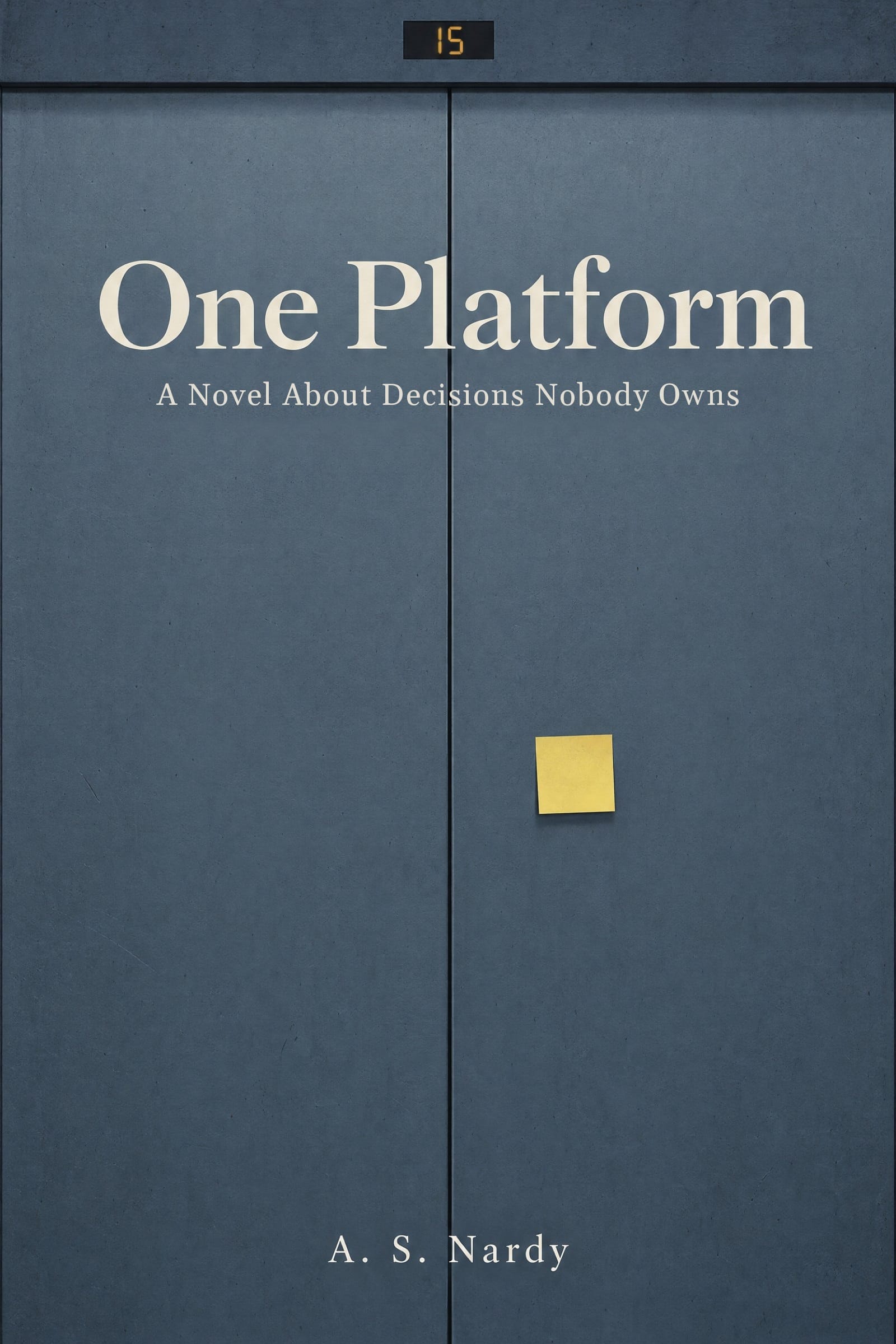
My first book is out. One Platform is a business novel, in the tradition of The Phoenix Project and The Goal, and it is available on Google Play Books in two editions: English and Bahasa Indonesia. I published it under the pen name A. S. Nardy.
The premise
At 1:40 a.m. on payday, tens of millions of people cannot top up their phones. The next morning, on the eighteenth floor, the room agrees that nothing went wrong: the meeting happened, the signatures are there, the minutes are tidy. One column in the decision log has been empty for four years.
Hendra used to be the one who took the 2 a.m. calls. Now he draws the maps — and the company is using his map to build One Platform, an eighteen-month program across six subsidiaries, overseen by a committee that decides everything and owns nothing.
Everyone agreed. Nobody owned it.
Why a novel, and not another framework article
I have written on this blog about decision debt, pragmatic architecture, and the gap between governance on paper and governance that actually holds in a meeting room. Those articles reach people who already agree with me. The people who need the argument most — the ones signing off on a program they cannot name an owner for — do not read architecture essays. They do read stories.
A novel also lets me show something an article cannot: how a reasonable decision, made by reasonable people, with every approval in place, still ends up with nobody accountable when it fails. There is no villain in One Platform. That is the point.
The question the book keeps asking is the one no governance template asks: if this stops halfway, who loses?
Why two editions
I wrote it in Bahasa Indonesia first, because that is the language the real version of these conversations happens in. The English edition exists because none of this is an Indonesian problem; every large enterprise I have compared notes with — telecom, banking, government — recognises the eighteenth floor. Both editions are the same book: same chapters, same characters, same ending. Pick the one you read faster.
Where to get it
- English edition — One Platform: A Novel About Decisions Nobody Owns on Google Play Books
- Edisi Bahasa Indonesia — One Platform: Novel tentang keputusan tanpa pemilik on Google Play Books (214 pages)
Google Play offers a free sample of the opening chapters.
A request
If you read it, I want to hear where you disagree — with Hendra, with the committee, or with me. The form on Ping Me! comes straight to my inbox, and the best objections will probably end up in a future post.